
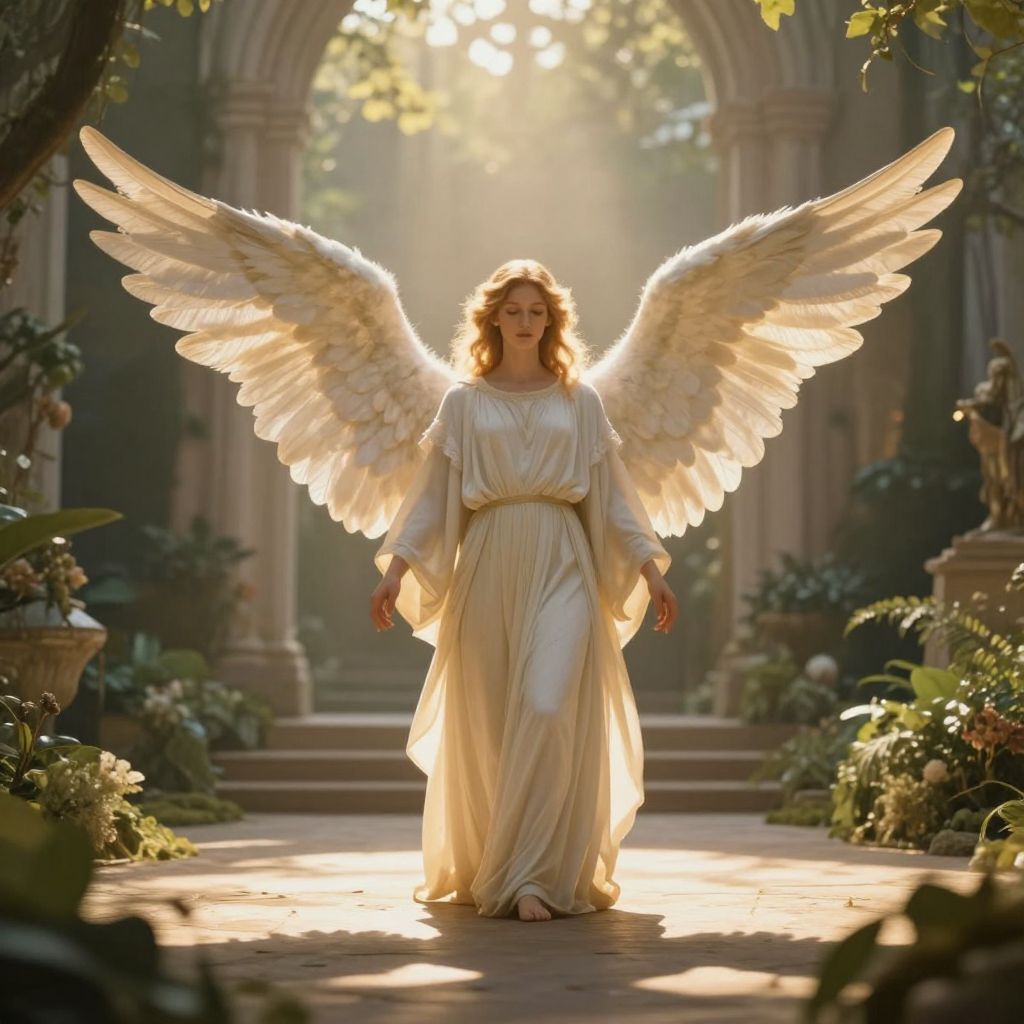
Angels appear throughout Scripture, yet many believers carry vague or even inaccurate ideas about what they actually look like and do. Hollywood gives us chubby babies with wings or glowing humans in white robes. But the Bible paints a far more awe-inspiring and sometimes startling picture of these heavenly beings. Understanding how Scripture describes angels draws us closer to the God who created them and commands them.
Angels Are Created Beings, Not Divine
Angels are not gods, and they are not to be worshiped. Scripture makes this distinction absolutely clear from beginning to end.
Colossians 1:16 (ESV) declares, “For by him all things were created, in heaven and on earth, visible and invisible, whether thrones or dominions or rulers or authorities—all things were created through him and for him.” Angels fall under this category of created beings, made by God for His purposes.
Angels Refuse Worship
In Revelation 22:8-9, the apostle John falls down to worship at the feet of an angel. The angel immediately stops him, saying, “You must not do that! I am a fellow servant with you and your brothers the prophets.”
This moment reveals something profound about angelic nature. Angels understand their place in God’s order and actively direct worship away from themselves and toward God alone.
Angels Possess Limited Knowledge
Unlike God, angels do not know everything. Jesus Himself stated in Matthew 24:36 that concerning the day and hour of His return, “no one knows, not even the angels of heaven, nor the Son, but the Father only.”
This limitation reminds us that angels, though powerful and wise, remain creatures under God’s sovereign authority. Have you ever assumed angels possess knowledge that Scripture says belongs only to God?
The Physical Appearance of Angels in Scripture
Here is where things get fascinating. Biblical descriptions of angels vary dramatically depending on their type and function.
Forget the greeting card imagery. Scripture presents angelic beings that range from human-like figures to creatures so unusual they defy easy description.
Angels Appearing as Men
Many biblical encounters show angels appearing in human form. In Genesis 18, three visitors come to Abraham, and he initially treats them as ordinary travelers, offering them food and water.
The angels who visited Lot in Sodom appeared as men (Genesis 19:1-5). The men of the city perceived them as human visitors, which led to the conflict that followed. When angels take human form in Scripture, they often appear as young men dressed in white or shining garments.
Angels of Dazzling Appearance
At the resurrection of Jesus, Matthew 28:3 describes the angel at the tomb: “His appearance was like lightning, and his clothing white as snow.” The guards trembled and became like dead men at the sight.
When the angel appeared to the shepherds announcing Christ’s birth, Luke 2:9 records that “the glory of the Lord shone around them, and they were filled with great fear.” Angels carrying God’s messages often display a radiance that reflects the glory of the One who sent them.
Seraphim: The Burning Ones
Isaiah 6:1-3 gives us one of Scripture’s most detailed descriptions of a specific type of angelic being. Seraphim (meaning “burning ones”) stand above God’s throne, each having six wings.
Two wings cover their faces, two cover their feet, and two they use for flying. They continually cry out, “Holy, holy, holy is the Lord of hosts; the whole earth is full of his glory!” These beings exist in such close proximity to God’s holiness that they cover themselves in reverence.
Cherubim: Not What You Expected
If someone mentions cherubim, you might picture the pudgy winged babies of Renaissance art. Biblical cherubim look nothing like that.
Ezekiel 1 and 10 provide the most detailed descriptions. Each cherub has four faces: a human face, a lion’s face, an ox’s face, and an eagle’s face. They have four wings, and their legs are straight with feet like calves’ hooves, gleaming like burnished bronze.
Cherubim guard sacred spaces. God stationed cherubim with flaming swords at the entrance to Eden after the fall (Genesis 3:24). Golden cherubim adorned the mercy seat of the Ark of the Covenant (Exodus 25:18-20).
The Living Creatures of Revelation
Revelation 4:6-8 describes four living creatures around God’s throne. The first resembles a lion, the second an ox, the third has a human face, and the fourth looks like an eagle in flight.
Each creature has six wings and is covered with eyes all around, even under the wings. Day and night they never cease to say, “Holy, holy, holy, is the Lord God Almighty, who was and is and is to come!”
The abundance of eyes may represent complete awareness and watchfulness. Nothing escapes their notice as they continually worship God.
Why Angels Often Say “Fear Not”
Have you noticed how often angels begin their messages with “Do not be afraid”? This phrase appears repeatedly because the natural human response to encountering an angel is terror.
When Gabriel appeared to Zechariah in the temple, Zechariah was “troubled” and “fear fell upon him” (Luke 1:12). When the same angel visited Mary, she was “greatly troubled” (Luke 1:29). Daniel, a man of great faith, fell on his face in deep sleep when an angel touched him (Daniel 10:9).
These responses tell us something important. Angelic encounters in Scripture are not warm, fuzzy experiences. They are overwhelming moments of contact with the supernatural realm. The need for reassurance speaks to the genuine power and otherness of these beings.
The Roles and Functions of Angels
Scripture reveals that angels perform specific duties in God’s service. Understanding their roles helps us grasp why God created them and how they operate in the spiritual realm.
Messengers of God
The word “angel” comes from the Greek “angelos,” meaning messenger. This role appears throughout Scripture:
- Gabriel announces the births of John the Baptist and Jesus (Luke 1:11-20, 26-38)
- An angel delivers instructions to Joseph in dreams (Matthew 1:20, 2:13, 2:19)
- An angel tells Philip where to go to meet the Ethiopian eunuch (Acts 8:26)
- An angel instructs Cornelius to send for Peter (Acts 10:3-6)
Warriors in Spiritual Battles
Angels engage in warfare in the spiritual realm. In Daniel 10, an angel explains that he was delayed for 21 days because “the prince of the kingdom of Persia withstood me” until Michael came to help him.
2 Kings 6:17 reveals that Elisha’s servant, when his eyes were opened, saw the hills full of horses and chariots of fire surrounding them. An unseen angelic army stood ready for battle.
Ministers to Believers
Hebrews 1:14 asks a pointed question: “Are they not all ministering spirits sent out to serve for the sake of those who are to inherit salvation?” Angels serve believers at God’s direction.
Angels ministered to Jesus after His temptation in the wilderness (Matthew 4:11). An angel strengthened Him in the Garden of Gethsemane (Luke 22:43). Psalm 91:11-12 promises that God commands His angels concerning His people, to guard them in all their ways.
Executors of God’s Judgment
Angels carry out divine judgment throughout Scripture:
- An angel struck down 185,000 Assyrian soldiers in one night (2 Kings 19:35)
- An angel struck Herod with illness because he did not give glory to God (Acts 12:23)
- Angels will gather the wicked at the end of the age for judgment (Matthew 13:41-42)
- Angels pour out the bowls of God’s wrath in Revelation (Revelation 16)
Worshipers of God
Perhaps the highest function of angels is unceasing worship. Isaiah’s seraphim cry “Holy, holy, holy” continually. The living creatures in Revelation worship day and night without rest.
Revelation 5:11-12 describes “myriads of myriads and thousands of thousands” of angels around God’s throne, saying with a loud voice, “Worthy is the Lamb who was slain, to receive power and wealth and wisdom and might and honor and glory and blessing!”
The Archangel Michael
Michael is the only angel specifically called an archangel in Scripture (Jude 1:9). The term means “chief angel” or “ruling angel.”
Daniel 10:13 calls Michael “one of the chief princes.” Daniel 12:1 identifies him as “the great prince who has charge of your people,” referring to Israel. Michael appears to have a special role as a protector and warrior.
In Revelation 12:7-9, Michael and his angels wage war against the dragon (Satan) and his angels, casting them out of heaven. Michael stands as a mighty warrior in God’s heavenly host.
What Angels Cannot Do
Understanding the limitations of angels protects us from unbiblical ideas about their nature and role. Angels are powerful, but they are not all-powerful.
- Angels cannot forgive sins (only God forgives)
- Angels cannot hear all prayers (they are not omnipresent)
- Angels cannot read minds (only God knows the heart)
- Angels cannot act independently of God’s will and authority
- Angels cannot save anyone (salvation belongs to the Lord alone)
1 Peter 1:12 reveals something remarkable: angels long to look into the things of salvation. The gospel amazes even these heavenly beings. They observe God’s redemptive work with wonder.
Fallen Angels: A Sobering Reality
Not all angels remained faithful to God. Scripture speaks of angels who rebelled and now serve as demons under Satan’s authority.
2 Peter 2:4 states that “God did not spare angels when they sinned, but cast them into hell and committed them to chains of gloomy darkness to be kept until the judgment.” Jude 1:6 refers to “angels who did not stay within their own position of authority, but left their proper dwelling.”
Revelation 12:4 symbolically describes Satan drawing “a third of the stars of heaven” with him in his rebellion. These fallen angels now oppose God’s purposes and work to destroy what God loves.
How Should We Respond to Biblical Teaching on Angels?
Knowing how Scripture describes angels should produce specific responses in our hearts and lives:
- Worship God, not angels. Angels themselves model this priority.
- Take comfort in God’s protective care, which includes angelic ministry.
- Recognize the reality of the spiritual realm around us.
- Test every spiritual experience against Scripture (even Satan disguises himself as an angel of light according to 2 Corinthians 11:14).
- Look forward to joining angels in eternal worship of the Lamb.
Are you living with an awareness of the spiritual realities Scripture reveals? The same God who commands the angelic hosts invites you into relationship with Himself through Christ.
Angels Point Us to Something Greater
Every biblical description of angels ultimately directs our attention not to the angels themselves, but to the God they serve. Their worship, their messages, their warfare, and their service all flow from and point back to God’s throne.
Hebrews 1 makes a remarkable comparison. After describing Christ’s superiority over angels, the writer asks, “To which of the angels did God ever say, ‘You are my Son, today I have begotten you’?” The answer is none. Jesus is greater than any angel.
Angels are glorious, powerful, and awe-inspiring. But they bow before the same Savior who calls you His own. That truth should take your breath away more than any six-winged seraph ever could.
If you found this exploration of angels in Scripture helpful, you may want to continue growing in your understanding of spiritual matters. Learn more about what Scripture teaches about asking angels for help, and discover biblical insight on the reality of demon possession and spiritual warfare. May your study of God’s Word deepen your faith and draw you closer to the One whom angels worship.